Maryone: Blending Art Nouveau Fluidity with Modern Brand Elegance
There’s a certain tension in modern design—the push and pull between the organic, flowing lines of historical art movements and the clean, structured demands of contemporary branding. Finding a typeface that doesn’t just sit in the middle but actually synthesizes these opposing forces is rare. You are likely familiar with the dilemma: you need a font that feels luxurious and artistic, perhaps for a high-end product or a creative portfolio, but standard serif fonts feel too stuffy, and geometric sans-serifs feel too cold. This is where the character of a specific design asset begins to shape the entire narrative of a project. It is in this space of high-end creativity and functional elegance that Maryone operates, offering a solution that feels both nostalgic and undeniably fresh.
The Visual Language: Ribbons, Curves, and Structure
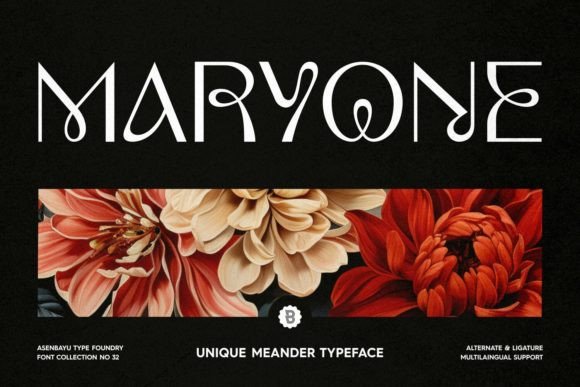
At its core, Maryone is a unique and stylish display font, but that description hardly captures the personality it brings to the canvas. The typeface is heavily influenced by the Art Nouveau movement, known for its ultra-fluid lines and organic shapes. However, rather than simply mimicking the past, Maryone modernizes these elements through a distinct technique: the use of beautiful folded ribbons. You can see this in the way the strokes of the letters seem to twist and fold over themselves, creating a sense of three-dimensional depth and movement without relying on heavy shadows or effects.
What makes this premium font particularly versatile is its construction. While the curves are intricate, the foundation presents an elegant modern impression with a sans-serif outline. This is crucial for designers who need visual flair without sacrificing legibility. The curves in each letter soften the impact, preventing the text from feeling too sharp or aggressive, which is a common issue with standard sans-serif display fonts. It strikes a balance where the typography feels like a design element in itself, rather than just a vessel for information.
Practical Applications: Where Maryone Shines
Understanding a font’s aesthetic is one thing; knowing where to deploy it is another. Because Maryone is a display font, it is designed to be used at larger sizes where its details can be appreciated. It is not intended for body copy in a novel, but it excels in scenarios where you need to capture attention immediately.
For branding and logo design, this typeface offers a distinct voice. If you are building a brand identity for a boutique clothing line, a high-end florist, a luxury spa, or a creative agency, Maryone provides that instant "boutique" feel. It suggests craftsmanship and care, which can elevate a small business’s perception in the market.
In packaging design, the folded ribbon effect can be used to mimic physical textures, such as wax seals, embossing, or actual ribbon on a box. It works beautifully for product labels, especially in the beauty, wellness, or gourmet food sectors. When applied to social media graphics, the font helps posts stand out in a crowded feed. Its unique silhouette stops the scroll, making it ideal for Instagram quotes, sale announcements, or header images for Pinterest boards.
Furthermore, consider the impact on print materials and merchandise. Wedding invitations, event posters, and tote bag designs often rely on typography to convey a mood. Maryone adds a layer of sophistication that generic fonts simply cannot match. It turns a simple invitation into a keepsake and a basic t-shirt into a fashion statement.
Strategic Typography: Improving Brand Recognition
Choosing a font is a strategic decision, not just an aesthetic one. When you use a distinct typeface like Maryone consistently, you build a visual shorthand for your brand. This contributes significantly to brand recognition. If a potential customer sees a social media post, a website header, and a physical brochure, the consistent use of this unique display font ties those experiences together.
There is also the matter of audience engagement. Typography affects how people feel about the content before they even read it. A font with Art Nouveau influences often evokes feelings of creativity, nature, and elegance. By using Maryone, you are subconsciously signaling to your audience that your brand values aesthetics and quality. This can lead to higher engagement rates on marketing assets because the visual presentation aligns with the expectations of a design-conscious audience.
Additionally, while display fonts are often purely decorative, Maryone’s sans-serif outline contributes to readability at scale. It ensures that while the font is artistic, it remains a functional tool for communication. You want your message to be seen and understood, and this typeface facilitates that clarity even with its decorative flourishes.
Integration and Pairing: Making It Work for You
A great font rarely works in isolation. To get the most out of Maryone, you need to consider how it fits into your broader typographic hierarchy. This is where font pairing becomes essential. Because Maryone has a strong personality, it pairs best with simpler, more neutral typefaces for body text.
For example, if you are designing a website, you might use Maryone for the H1 and H2 headers to draw the eye, but switch to a clean, geometric sans-serif or a highly legible serif font for the paragraph text. This contrast creates a visual rhythm that guides the reader through the content. The headers provide the flair, while the body text provides the comfort needed for longer reading sessions.
When selecting your pairings, consider the mood. If you want to lean into the elegance, a classic serif font can complement the curves of Maryone. If you want to modernize the look further, a minimalist sans-serif creates a striking contrast. The key is to avoid competing for attention; let Maryone be the star of the show for headlines and titles.
Technical Considerations and Commercial Use
Before integrating any new design asset into your workflow, practical considerations must be addressed. As a commercial font, Maryone is typically licensed for specific uses. Whether you are a freelance designer creating assets for a client, or a business owner using it for your own merchandise, it is vital to review the licensing terms. Ensure the license covers your intended use, whether that is digital products, print-on-demand merchandise, or desktop installation for a team.
It is also worth taking the time to explore the full character set of the font. Premium fonts often include alternates, ligatures, and stylistic sets that can add even more variety to your designs. Experiment with these features in your design software. You might discover that a specific letter combination looks better with a ligature enabled, or that swapping out a standard "g" for an alternate version better suits your layout.
Finally, always test your typography in context. A font that looks great on a white background might lose its impact on a busy photograph, or a dark mode website. Check the legibility of Maryone across the different mediums you plan to use. Does it hold up on a mobile screen? Does it print clearly on textured paper? These checks ensure that your investment in a quality typeface translates into professional, high-quality results for your projects.