Harmesh: Crafting Enchantment with a Fantasy Fairytale Typeface
There’s a moment in every design project when you need to do more than just convey information—you need to create a feeling. You want to evoke wonder, a sense of history, or a touch of magical realism. This is where a typeface transcends its role as simple text and becomes a storyteller. Imagine letterforms that feel like they’ve been lifted from an illuminated manuscript or a dusty storybook, yet are refined enough for modern use. That’s the promise of a font like Harmesh, a fantasy fairytale typeface designed to inject ornate elegance and narrative depth into your work.
More Than Just Letters: The Visual Soul of Harmesh
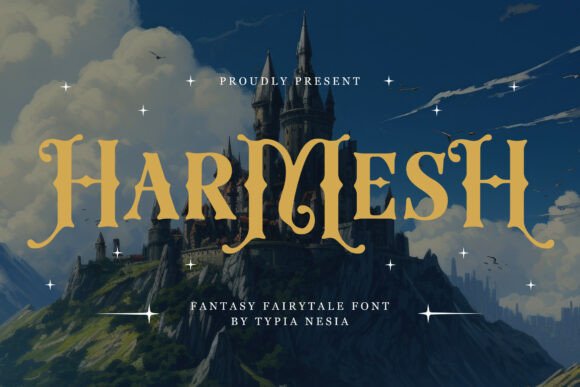
Harmesh isn’t your typical serif or sans serif font. It’s a premium display font steeped in medieval aesthetics and classic fairytale charm. Its personality lies in the details: ornate serifs that curl with delicate flourishes, decorative ligatures that weave letters together in an artful dance, and a full suite of alternate characters that give you immense creative control. Think of it as a toolkit for building typographic magic. The base letterforms are strong and legible, but the swashes and alternates allow you to customize headlines, logos, and titles to make them uniquely yours. This isn't just about writing a word; it's about designing an emblem.
What makes it visually compelling is its balance. It avoids looking overly cartoonish or kitschy. Instead, it draws on the craftsmanship of vintage typography, offering a sophisticated take on fantasy. The curves feel intentional, the weights are well-considered, and the overall impression is one of timeless elegance. For designers, this means you can use it to create a powerful brand identity for a fantasy-themed business, or simply add a headline to a poster that needs a dose of whimsical gravitas without sacrificing professionalism.
Practical Magic: Where This Typeface Truly Shines
Understanding a font’s aesthetic is one thing; knowing how to deploy it effectively is another. The true value of a creative font like Harmesh is unlocked when you match its strengths to specific project goals. It’s not a body text workhorse—it’s a star player, best used for moments of high impact where you want to capture attention and set a specific mood.
Consider these real-world applications:
- Brand Identity & Logo Design: For a fantasy author, a specialty tea brand with a storybook theme, a board game company, or a boutique hotel with a rustic, old-world feel, Harmesh can form the core of a memorable logo. Its unique character helps with instant brand recognition.
- Packaging & Merchandise: Product packaging for artisanal goods, cosmetics, or craft supplies can benefit from its vintage charm. It translates beautifully onto merchandise like tote bags, mugs, or t-shirts, giving items a premium, curated look.
- Editorial & Print Design: Think beyond the obvious. Use it for chapter headings in a novel, for the title of a magazine feature on folklore, or for elegant event invitations. It adds a layer of sophistication to any print layout.
- Digital & Social Media: In the crowded space of social media graphics, a scroll-stopping headline is key. Harmesh can make a promotional post, a blog header, or a YouTube thumbnail stand out. For websites, it’s perfect for hero section headings or special announcement banners, provided you pair it with a highly readable body font.
- Game & Entertainment Design: This is a natural fit. Use it for game titles, menu screens, in-game UI elements for fantasy-themed apps, or promotional posters for a theater production or a Renaissance fair.
The key is to use it strategically. A single, well-placed headline in Harmesh can elevate an entire design, giving it a cohesive and intentional feel. It acts as a visual anchor that tells your audience, “This project has a story.”
Integrating a Specialty Font into Your Workflow
Adopting a new display font into your design toolkit requires a bit of thoughtful consideration. Here’s how to approach it practically to ensure it works for you, not against you.
Pairing is Everything. A highly decorative font like Harmesh needs a clean, simple partner. Don’t try to compete with another ornate typeface. The most effective combinations often involve a straightforward sans serif or a classic, neutral serif font for body copy. For example, pairing Harmesh with a font like Lato, Open Sans, or even a simple serif like Georgia creates a beautiful contrast that ensures readability while letting the display font command attention.
Test for Readability. Always test your chosen words at the intended size and on the target medium. Some of the more elaborate alternate characters or ligatures might be stunning at a large poster size but could become cluttered or illegible at a small scale, like on a business card or a mobile screen. Use the font’s alternates wisely to enhance, not hinder, communication.
Leverage the Full Toolkit. A font like Harmesh often comes with more than just the basic alphabet. Explore what’s included. Are there stylistic sets? Swash alternates? PUA-encoding (which means you can access all glyphs easily from any application)? Understanding your full toolkit allows you to create custom letter combinations that are truly unique to your project, moving beyond the default setting.
Understand the License. For any commercial project, whether it’s for a client or your own business, you must ensure you have the correct license. A font marketed for commercial use should clearly outline its terms. This is a critical step in professional practice, protecting you and your client and respecting the work of the type designer.
Final Thoughts on Typographic Storytelling
Choosing a font is a decision about voice. Harmesh offers a very specific, powerful voice—one that speaks of magic, elegance, and timeless stories. It’s a specialized tool in a designer’s kit, perfect for when the brief calls for enchantment over minimalism. By understanding its visual personality, applying it to the right kinds of projects, and integrating it thoughtfully with other design elements, you can use it to create work that doesn’t just look good, but feels genuinely special. It’s a reminder that sometimes, the most effective communication happens when we dare to add a little wonder to the words.